Network Speeds
| nominal speed |
UDP | TCP/IP | ||
| cellphone | to 38.4 kbps | 10 kbps | "handy" in Europe | |
| V.34 | 56 kbps | 30 kbps | modem | |
| ISDN | 64 kbps/ch | 50 kbps/ch | ISDN | |
| cable, DSL | ~1.5 Mbps | 500 kbps | "broadband" | |
| Bluetooth | to 1 Mbps | ~30 feet | ||
| T1 | 1.5 Mbps | 24 channels | ||
| E1 | 2 Mbps | "Euro T1" 32 channels | ||
| 2 GHz UMTS "3G" | 2 Mbps | ~60 kbps | "gouge-o-matic" | |
| Ricochet | 128 kbps | ~60 kbps | 900 MHz | |
| D2B | 5.6 Mbps | car fiber, 1992+ | ||
| 5.9 GHz DSRC | 6 Mbps/ch | 3.4/ch | 2.7/ch | inter-vehicle, ~600 ft/hop |
| ethernet | 10 Mbps | |||
| 2.4 GHz 802.11b | 11 Mbps | 7.1 | 5.9 | Wi-Fi, wireless ethernet |
| 2.4 GHz 802.11g | 54 Mbps | 16.9 | 11.8 | faster wireless ethernet |
| 10-66 GHz 802.16 | 70 Mbps | 7 over 12 mi | WiMAX wireless broadb. | |
| MOST | 25 Mbps | car fiber, 2002+ | ||
| T3 | 45 Mbps | past net backbone | ||
| OC-1 | 52 Mbps | slowest fiber, not used | ||
| 5.9 GHz 802.11a | <54 Mbps | 30.9 | 24.4 | Driveby InfoFueling, 2001 |
| fast ethernet | 100 Mbps | |||
| MOST 150 | 150 Mbps | car fiber, 2012+ | ||
| OC-3 | 155 Mbps | 150 | 120 | |
| 2.4/5 GHz 802.11n | 600 Mbps | 240 | dual band, 4 channel | |
| OC-12 | 622 Mbps | 600 | 470 | present net backbone |
| record over 6800 mi | 923 Mbps | 923 | Stanford-Amsterdam | |
| gigabit ethernet | 1 Gbps | Telseon, Yipes | ||
| HDTV | 1.2 Gbps | uncompressed video | ||
| MOST x 50 | 1.25 Gbps | automobile glass fiber | ||
| OC-48 | 2.5 Gbps | 2.4 | 1.9 | telco backbone |
| OC-192 | 10 Gbps | 9.6 | 7.5 | popular, e.g. Qwest |
| fast gigabit ethernet | 10 Gbps | |||
| OC-48 with WDM | 40 Gbps | wave division multiplexed | ||
| OC-768 | 40 Gbps | "NExt step" e.g. AT&T | ||
| AC-1 | 160 Gbps | atlantic crossing | ||
| OC-3072 | 160 Gbps | "Duh, that's pretty fast" | ||
| Yellow/AC-2 | 640 Gbps | 320 Gbps lit | ||
| Apollo | 3.2 Tbps/leg | DWDM | ||
| OC-768 w DWDM | 6.4 Tbps | e.g. Enkido | ||
| DWDM | 10 Tbps | dense WDM | ||
| glass fiber | 75 Tbps | fiber capacity |
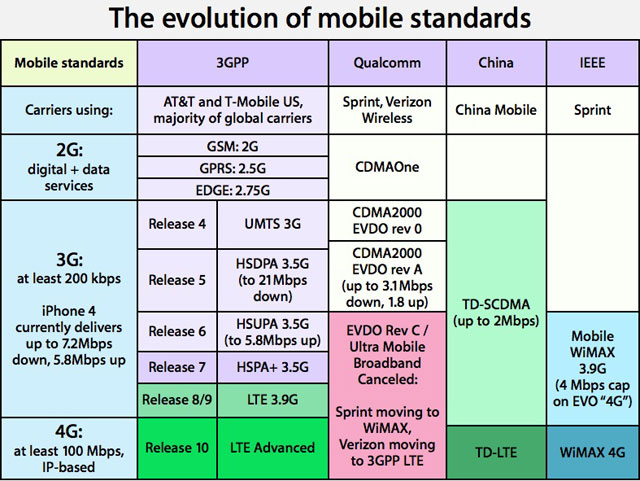 Apple Insider
|
kbps:     Kilo  bits per second                                    1,000 bps
Mbps:     Mega  bits per second                                1,000,000 bps
Gbps:     Giga  bits per second                            1,000,000,000 bps
Tbps:     Tera  bits per second                        1,000,000,000,000 bps

Pbps:     Peta  bits per second                    1,000,000,000,000,000 bps
Ebps:     Exa   bits per second                1,000,000,000,000,000,000 bps
Zbps:     Zetta bits per second            1,000,000,000,000,000,000,000 bps
Ybps:     Yotta bits per second        1,000,000,000,000,000,000,000,000 bps
With Wave Division Multiplexing (WDM), using different optical wavelengths, the fiber bandwith can be increased by a factor of about 16. "Narrowband dinosaurs" are deploying WDM since it is less expensive than laying more fiber. Dense Wave Division Multiplexing (DWDM) uses high-Q laser photons with single lambda bandwidth, limited only by the uncertainty principle discovered by Werner Heisenberg, allowing up to 10,000 adjacent channels within the amplifier gain! |
|
Ride the light. |